Showing posts with label Recipe. Show all posts

Wednesday, June 13, 2012

Polecat Porter Revisited

It’s been said that one of the marks of a good brewer is repeatability.  As long as you have some basic processes down, it’s possible to get lucky now and again and produce a fantastic beer.  To be able to make that exact same beer a second time though, one that’s not just close but a mirror image, well, that’s a different story.  Back in August of 2011, I attempted this by re-brewing my Polecat Porter for the first time and even though I followed my recipe and processes to a tee, the end beer was a far cry from the original.  It lacked body, color, malt complexity and just ended up being an overall disheartening experience.    

Looking over my recipe and notes, it was hard to tell exactly where things went wrong.  The mash was identical, I hit all of the same numbers, and the fermentation proceeded in the same manner.  The only place where there was any room for differentiation was in the grist itself.  Even though I used the same recipe, I never recorded which maltsters supplied my grain and with chocolate grain as an example, SRMs can vary from 300 to 650 depending on which variety you select. 

With NHC being a huge focus of mine for the last year or so, my brew schedule was pretty tight and I wasn’t planning on re-brewing my Polecat for the event.  However, since my homebrew club (The Homebrewers Guild of Seattle Proper) picked up a second Hospitality Suite shift, we decided to re-brew and showcase all of our previous Pro-Am winning beers during the Thursday night shift.   Only being two months out, I was low on time for a Baltic porter since I normally would lager it for at least 3 months, but I selected the maltsters with the most appropriate grains (based on what was lacking in my original re-brew) and set to brewing.

As expected, the beer is and will be a little green on Thursday, June 21st, but it’s significantly closer to my Pro-Am version than my first re-brew.  If you’re coming out to NHC, come by the Hospitality Suite after Pro Night on Thursday, give it a sample, and let me know what you think.  I also managed to salvaged my first re-brew by eising it and I’ll be serving that at our booth on Club Night as well.  Try ‘em both and see what you think.

Recipe Specifics
------------------
Batch Size (Gal): 6.5
Total Grain (Lbs): 19.88
Anticipated OG: 1.087
Anticipated SRM: 32.8
Anticipated IBUs:   37.2
Wort Boil Time:  90
Final Gravity: 1.021
ABV: 8.8%

Grain/Fermentables
-------------------------
57.4% - 11.5 lbs Munich Malt (Weyermann)
33.7% - 6.75 lbs Pilsner (Weyermann)
2.5% - ½ lb Special B (Castle)
1.9% - 6 oz. Carafa 3 (Weyermann)
1.2% - ¼ lb CaraMunich 3 (Weyermann)
1.2% - ¼ lb Chocolate Malt (Crisp)
1.2% - ¼ lb Crystal 80 (Breiss)
0.9% - 3 oz. Molasses (Grandma's)

Hops
-------
60 grams Czech Saaz (pellets, 5.0% AA) @ 65 minutes
20 grams Hallertau (pellets, 4.1% AA) @ 25 minutes

Yeast
-------
Wyeast 2124 Bohemian Lager (2nd Generation, from Chocolate Rye Lager)

Water Profile and Additions
----------------------------------
Charcoal filtered Seattle Water
Mash:  0.5 g/g Calcium Chloride, 1.5 g/g Baking Soda
HLT: 0.1 ml/g phosphoric acid
Boil Additions: 1 g/g Calcium Chloride, 0.35 g/g Epsom Salt   

Mash Schedule
-------------------
60 minute rest at 151°
15 minute mash out rest at 168°
Sparged with 170° water
Notes
--------
4/5/2012 – Racked Chocolate Rye Lager off of the yeast and washed.  Placed in fridge.

4/8/2012 – Brewed solo.

Doughed in at 157° and mash settled at 151.5°.  Mixed mash every 20 minutes for a total of 60 minutes before raising temp to 168°.  Sparged with 170° water for a long time, collected 7 gallons of 1.078 wort, and topped off to 8 gallons.

Boiled for 90 minutes.  All hop additions were placed in their own hop sacks with plenty of room inside, but I pushed the sacks down and around every 15 minutes or so with a long spoon.  Molasses went in at 30 minutes.  Ended with 6.3 gallons of 1.087 wort.

Chilled down to below 60° and then moved entire kettle to fridge with temp set to 40°.  In the morning, I racked over 5.5 gallons of clear wort and oxygenated for 60 seconds.  Since the yeast slurry was kept in the same fridge, I decanted any liquid on top, added some of the Polecat wort, swirled around to thin it, and then pitched it in to the carboy.  Temp set to 50°.

5/1/2012 – Raised temp to 59°.

5/3/2012 – Gravity down to 1.023.  Slowly started lower temp to 35 over the course of the next 7 days.

5/13/2012 – Transferred to a keg for lagering (34°).  Gravity down to 1.021.

6/7/2012 – Racked over to new keg and carbonated.
 

Sunday, April 8, 2012

Chocolate Rye Lager

Back in mid-February I made the journey down to LA to visit an old friend and while there, we headed over to the Bruery to sample some of their offerings.  Alright, the real reason I went down was to pick up my 2011 Bruery Reserve Society beers, but I sound much less like an insanely beer-obsessed nerd if I play the friend card before the beer.  Oh well, a spade’s a spade I suppose.  Anyway, while there, we tried a number of their on-tap beers and one that really surprised me was their Chocosaurus Rye.  This collaboration brew with the guys at Bootlegger’s is a dark rye lager that they then aged for a bit on cacao nibs and vanilla beans.  Honestly, the description sounded more like a mess than a masterpiece to me, but they pulled it off and I was impressed with how well the chocolate melded with the rye (probably due to the slight vanilla in there and the low roast character).  Since I wanted to build up a large volume of lager yeast for my next iteration of Polecat Porter, this seemed like a fun beer for replication.

Developing the recipe for this beer was fairly simple since there’s quite a bit of information in a video that they made on brew-day.  It’s difficult to tell whether they mention “base and Munich malt” or “base of Munich”, but regardless, I’m 10 steps ahead of starting completely blind.  Aside from the grist, the only real deviation that I made from their mentioned recipe is the yeast.  While it sounds like they use a German lager strain, I wanted to re-purpose the yeast for my Polecat Porter and since I’ve used Bohemian for that in the past, I decided that I’d start with it for this beer.

While I’m confident that the base will turn out decently given the amount of information they’ve reported, aging the beer on cacao nibs will be a bit of a gamble.  My last foray with nibs, a chocolate pumpkin porter that I brewed years ago, might possibly be the worst beer I’ve ever brewed and I haven’t been too excited to play with them ever since.  I did make the mistake of aging the beer on raw nibs, and probably for too long as well (a month and a half), which resulted in a harsh bitterness that wasn’t present before the nib addition.  This time, after researching various methodologies and talking to friends about their failures and successes with the nibs, I plan to use roasted nibs from a local chocolatier (Theo), presoak them in a bit of vodka as a vehicle for extracting some of the non-water soluble flavor and aroma compounds, and aging the beer on the nibs for a short period of only 3-7 days.    Hopefully using this method will impart the natural bitter-sweet chocolate flavor that I’m looking for and by sampling daily, I’ll be able to transfer the beer off the nibs before any negative flavors start to develop.

Recipe Specifics
Batch Size (Gal): 6
Total Grain (Lbs): 16.75
Actual OG: 1.067
Final Gravity: 1.015
Anticipated SRM:  36
Anticipated IBUs:   25
Wort Boil Time:  60

Grain Bill
30.2% - 4.75 lbs Breiss Rye Malt
28.6% - 4.50 lbs Weyermann Munich Type 2
27.0% - 4.25 lbs Gambrinus 2-Row
7.9% - 1.25 lbs Flaked Oats
6.3% - 1.0 lb Breiss Midnight Wheat
1.0 lb Rice Hulls

Hops/Spices
40 grams Styrian Goldings (pellets, 5.2% AA) @ 45 minutes
4 oz. Theo Organic Roasted Cacao Nibs @ secondary for 3-7 days
1 Tahitian Vanilla Bean (Split) @ secondary for 3-7 days

Yeast
Wyeast 2124 Bohemian Lager

Water Profile and Additions
Charcoal filtered Seattle Water
Mash Additions: 0.5 g/g Calcium Chloride
HLT Additions: 0.1 ml/g Phosphoric Acid (0.75ml)
Boil Additions: 1 g/g Calcium Chloride and 0.35g/g Epsom Salt

Mash Schedule
90 minute rest at 146°
15 minute mash out rest at 168°
Sparged with 170° water

Notes

3/1/12 – Added two packets of Wyeast 2124 to 2.5L of starter wort and placed on stirplate at 54°.  After 36 hours, another 1.5L of wort was added.  36 hours later, started was placed in fridge to crash cool and drop the yeast.

3/11/12 – Brewed solo.

Doughed in at 153° and mash came to rest at 147°.  Made mineral additions and mash pH came in at 5.16 and HLT at 5.26.

90 minute mash and a long sparge.  Collected 5.25 gallons of 1.082 wort with final runnings stopping at 1.046.  Topped up to about 7.3 gallons. 

Boiled for 60 minutes (post break) and since only 1 hop addition, I used a hop sack.  Finished with 6.25 gallons of 1.067 wort.

Chilled down to 48° and let rest for about a half hour.  Decanted yeast starter and added about a quart of wort from the kettle.  Placed both yeast and carboy in fermentation chamber at 47° and let rest for 30 minutes. 

Oxygenated for 90 seconds and then pitched in yeast.  Set fermentation chamber at 49°.

4/1/12 – Sampled and gravity down to 1.0155 so I bumped up temp to 58° for a diactyl rest.

4//4/12 - Crash cooled to 33°

4/712 - Racked over and onto 4oz, by weight, of Theo Cacao nibs (which had been soaking in Bend Distillery's Crater Lake Vodka for 24 hours...just enough to cover the nibs) and 3/4 Tahitian vanilla bean (split and seeded...and also had been soaking in 5ml of Vodka for 2 hours).  


Monday, February 13, 2012

Naked City Collaboration RIS

Courtesy of club member, Nick L.
Back in the fall of 2011, the Washington Homebrewers Association (WAHA) sent out an email to all of the Washington AHA registered homebrew clubs to see if there was any interest in working on their own commercial collaboration brew for the NationalHomebrewer’s Conference ( Bellevue, WA in June 2012).   Our highly motivated club, the Homebrewers Guild of Seattle Proper, jumped at the opportunity and responded right away.  Unfortunately it seemed as though WAHA wasn’t quite as ready to begin the process as they originally expected, and so rather than waiting until their anticipated start date of Spring 2012, we began the process on our own.  One of our first choices, and a favorite brew pub among many of our club members, NakedCity seemed like the ideal candidate for such a collaboration project.

Courtesy of club member, Nick L.
Although we would have been more than happy to brew anything with Don, the brewer and owner of Naked City, we decided that as a club, we should come up with a few ideas to present to him beforehand.  One club member had recently picked up a 30 gallon whiskey barrel from the Woodenville Whiskey Company which was recently drained of their Harvest Release American Whiskey.   We had been planning on using it for a club project, but with the advent of a collaboration brew and a little time on our side, we thought it would be fun if we could brew a larger batch of beer on Naked City’s system and then age a portion of it in our whiskey barrel.   If it comes out too strong, we can use some of the standard version to blend back and if not, we’ll have a fun, 100% barrel aged collaboration brew to serve at NHC.

Courtesy of club member, Nick L.
With the decision made to use the whiskey barrel for the Naked City project, the 8 of us in our club next debated about what to fill it with.  A multitude of ideas were tossed about, but in the end, Don and the other members of our club decided to go with the always-popular-among-beer-nerds Russian Imperial Stout.  Fitting of his completely laid back style, Don left the recipe formulation completely up to us and so in designing the grist and recipe, we went with a combination of grains that leaned towards a chewy, chocolate base with a mild residual sweetness and just enough clean bittering hops to keep it from being cloying.   One of our secret ingredients that we were planning on using was Golden Naked Oats, which is a mild caramel malt that adds a touch of nutty sweetness along with a velvet like texture.  Unfortunately on brew day, after adding all the grains to the mash tun, we realized that flaked oats were added instead of Golden Naked Oats.  With 7% of the grist once scheduled for this caramel malt and now substituted for flaked oats, it’ll be interesting to see if the roast is now running strong in the forefront or if there’s enough residual sweetness to balance out the hops.  We ended up mashing at 154° instead of the originally planned 149°, and with the increase in temp, hopefully the slightly less fermentable wort will result in body and sweetness closer to what we originally intended.

All in all it was a great brewday at Naked City and I can’t wait to see how both the barrel-aged and standard version turn out.  If by chance you’re headed to NHC this year, come check us out and see for yourself what you think of our collaboration brew.

Opacity

Recipe Specifics
Batch Size (Gal): 100
Total Grain (Lbs): 427
Anticipated OG:  1.110
Actual OG: 1.100
Final Gravity: 1.024
Courtesy of club member, Bob Y.
Anticipated SRM:  57
Anticipated IBUs:   121
Wort Boil Time:  120 minutes
Pre-Barrel ABV:  10.2%

Grain Bill
48.2% - 206 lbs Gambrinus Pale Malt (2-Row)
28.8% - 123 lbs Gambrinus ESB Malt
7% - 30 lbs Golden Naked Oats Flaked Oats
4.4% - 19 lbs Roasted Barley
3.6% - 15 lbs Chocolate Malt
3.6% - 15 lbs Pale Chocolate Malt
2.3% - 10 lbs CaraMunich 40
2.3% - 10 lbs Special B

Hops
1400 grams Magnum (pellets, 14.0% AA) @ 60 minutes
300 grams East Kent Goldings (Pellets, 5.0% AA) @ 15 minutes

Yeast
White Labs WLP039 Nottingham (Slurry from Naked City’s Mayfield Mild)

Water Profile and Additions
Mash: 1.0 g/g baking soda (see notes below)
Boil: 1.2 g/g Calcium Chloride, 0.35 g/g Epsom Salt

Mash Schedule
60 minutes @ 154°

Notes
1/13/12 – Brewed with the club and Don at Naked City

Don had all the grains milled and ready to go.  Doughed in and settled at a rest temp of 154°

According to our calculations, we needed about 2.0 grams per gallon of baking soda to reach our target mash pH of 5.3.  Taking it slow, we added in half the amount (145 grams) and then measured the pH…6.0.  It should have been way below this, so we opted to not make any more additions.  After realizing the grain issue, we speculated that the lack of 30 lbs of crystal malt caused our initial pH to be higher than expected.  Adding the 145 grams of baking soda only increased it further, so without it, we probably would have been in about the perfect range.

Boiled for 2 hours with mineral and hop additions as noted above.  Minerals went in at 60 minutes.

Whirlpooled for 30 minutes, and then chilled as we racked off (using plate chiller).  Oxygenated inline and pitched yeast at about 70 degrees with fermentor set at 68.

2/9/12 - Beer was transferred out of fermenter and into barrel and brite tank.

Thursday, January 26, 2012

Bière(s) de Garde - (Le Trois Mandragores)

For whatever reason, I’ve never really had a shortage of patience in my life.  I have no problem lagering a Baltic porter for months on end or waiting for oak to impart its subtleties into a bourbon tripel.  However, when it comes to brewing a wild ale, it’s not the fermentation/maturation period that kills me but rather the decision to dedicate an entire brew day to something that won’t be ready for years.  How does one choose to spend 8 hours of their day for an acidic ale that won’t be ready for a few years when you could use the same amount of time to brew something that will be ready in weeks?  I’ve struggled and pushed back many a wild ales because of this, but my solution as of late has been to brew two beers in one day using the same base. 

While there are a number of base styles that could work for this strategy, for my latest batch, I chose to go with a brown bière de garde.  Being more malt driven and less hop-focused, I’ve always enjoyed the fruity character with the biscuit/bread backbone in the standard style.  For the diluted portion that I’ll sour, the high gravity should provide lots of food for the organisms to feed on and the low bitterness won’t clash with the subtle, sour flavors (I’m not concerned about the impact on hop-sensitive Lactobacillus as I’m planning on most of the acidity being generated by pedio). 

The idea of creating two beers out of one was simple enough, but unfortunately the brew-day was not without problems.  Since I only have a 10 gallon boil kettle, my plan was to finish with 7.5 gallons of highly concentrated wort (1.146 SG) which would then be split and diluted into two batches:  6 gallons of 1.075 gravity wort for the standard and 6 gallons of 1.065 for the sour portion.  In order to pull this off, I filled my mashtun with 34 lbs of grain and 9 ½ gallons of water…which brought the total volume in my tun up to about a half inch below the cutout where my recirculation hose re-enters.  With my mashtun maxed out, the grain bed compacted and my recirculation was compromised.  Before I realized what was happening, the pump had sucked all of the wort from underneath the grainbed and pumped it back on top…which resulted in the liquid level rising in the tun and a small amount draining out through the recirculation intake cutout.  It was a slow process to mix them in, but luckily the pound or so of rice hulls that I had on hand was able to loosen the grain bed enough to allow for the liquid to once again flow freely through.

In order to hit 6 gallons of 1.075 wort and 6 gallons of 1.065 wort, I needed to transfer over 3.08 and 2.67 gallons into their respective carboys.  As I was working on the 3.08 batch, even after a 2 hour resting period, an inordinate amount of break material was carried over.  Since this material shouldn’t count in the 3.08 gallons of wort that I needed, I decided to rack over an additional ¾ gallon or so.  From there, it was sort of guesswork.  Earlier in the day, I boiled 5 gallons of water, chilled it down, and transferred it over to a keg.  From this keg, I filled up each carboy to about the 6 gallon mark and somehow ended up with 1.088 in one and 1.071 in the other.  Needless to say, it was very frustrating to not hit my intended marks after a long day of brewing.   

The plan from the beginning was to start the fermentation for each with Wyeast 1338 European ale yeast at 59- 60 degrees (current ambient temp in my basement).  Thinking that the 1338 might not leave the standard version dry enough, after a few days, I’ll pitch in a packet of Wyeast 2565 Kolsch yeast to finish the job.  At the same time, I’ll stop the fermentation in the soon-to-be sour version by crashing it at 30 degrees.  Not only should there be plenty of residual sugar left over since attention should only be about 50% complete at this point, but the oxygen will be fully scrubbed out and the pH will have dropped.  Hopefully both of these conditions will provide for an environment that’s more hospitable for the bacteria and one that won’t be too conducive to brett reproduction.  Some brett growth will be fine, but I’d hate for it to rip through all of the residual sugar quickly, leaving nothing behind for the bacteria to acidify over time. 

Various Sour Starters
Using the 1.088 batch as the sour version, after dropping the 1338 yeast I’ll rack over 4.25 gallons into a new carboy, top off with 1.5 gallons of water, and pitch in my brett and bacteria.  This should have the same effect as if I were originally starting with 1.065 wort.  Using the remaining 1.088 wort, I’ll be able to rack over 1.5 gallons into another carboy, top off with 1.25 gallons of water, and basically have another sour beer with an OG of 1.048.   

In the end, even though the brew day itself was fraught with issues and frustration, I’ll walk away with about 5 gallons of finished Bière de Garde and 8.5 gallons of various wild ales.   

Bière(s) de Garde (Le Trois Mandragores)

Recipe Specifics
Batch Size (Gal):  7.5
Total Grain (Lbs):  34 ¼
Anticipated OG:  1.147 (pre-dilution)
After Dilution:   Standard Version (Seigneur de Mandragore) – 1.075
                        Sour 1 (Plissement de Mandragore) – 1.065
                        Sour 2 (Boules bleues de Mandragore) – 1.048
Anticipated SRM:   26 (pre-dilution), 12.6, 11, and 8 after dilution.
Anticipated IBUs:  52 (pre-dilution), 25, 22, and 16 after dilution.
Wort Boil Time:  210 minutes
Anticipated ABV:  7.2%, 8.6%, and 6.3%

Grain/Fermentables
30.5% - 11 ½ lbs Vienna Malt
26.5% - 10 lbs Maris Otter
23.8% - 9 lbs Munich Malt (10L)
7.9% - 3 lbs Light DME
4.0 % - 1 ½ lbs Aromatic Malt
2.0 % - ¾ lbs Biscuit Malt
1.3% - ½ lb Carafa Special II (420L)
1.3% - ½ lb CaraMunich 60
1.3% - ½ lb CaraVienne
1.3% - ½ lb table sugar

Hops
60 grams Northern Brewer (Pellets, 9.8% AA) @ 60 minutes
20 grams Saaz (Pellets, 5.5% AA) @ 30 minutes
20 grams Hallertauer (Pellets, 4.1% AA) @ 15 minutes

Yeast
Seigneur de Mandragore (Standard version) – Wyeast 1338 European Ale (2 packs into 3500ml starter.  Decanted, and pitched about half).  3 days later, added a swelled pack of Wyeast 2565 Kolsch.
Sour base (pre-split and dilution – 1.088 gravity) – Added 2nd half of Wyeast 1338 European Ale starter.

Water Profile and Additions
Charcoal filtered Seattle Water
Mash Additions: 0.4 gram/gallon Calcium Chloride, 1.0 gram/gallon Baking Soda (based on 9.5 gallon mash) – pH came to 5.41
Sparge Additions: Adjusted pH down to 5.3 using phosphoric acid (@150°) – 0.8ml per 7.5 gallons.
Boil Additions: 0.3 grams/gallon Calcium Chloride, 0.8 grams/gallon Epsom Salt, and 0.75 grams/gallon Salt (all based on 7.5 gallons final volume) 

Mash Schedule
Doughed in @ 161° and mash settled at 150°.
90 minutes @ 150° (due to stuck mash/recirculation issues)
30 minutes @ 168°
2 hour sparge @ 170° - Started boil as soon as there was about a gallon in the kettle.

Notes
1/8/2012 – Added 2 packs of Wyeast 1338 European ale to 3500ml of wort and placed on stir plate for 48 hours.  Placed in fridge to drop yeast.

1/14/2012 – Brewed solo.
Collecting Hot Chiller Waste Water For Mash

Boiled 6 gallons of water and chilled to 70 degrees.  Used hot, waste chiller water in mashtun.  Racked chilled water into a sanitized keg.

Doughed in @ 161° and mash settled @ 150°.  Due to volume and weight, the mash stuck and I lost about a cup or two of wort out of the recirculation return cut-out.  Cut recirculation, removed about 10 cups of liquid into a bowl to make some temporary room, and then slowly mixed in 1 – 1.5 lbs of rice hulls.  After they were mixed in, I restarted the recirculation and added back the previously removed wort.

Slow sparge (2 hrs).  Started flame when there was about a gallon in the kettle and boiled all the way through 9 gallons. Added a few NB pellets a little before first sign of boil.  After an hour, gravity wasn't high enough, so I collected an extra gallon of sparge (final runnings after last gallon had SG of 1.051) and added it to the boil.  Added in 3 lbs of light DME and a 1/2 lb of table sugar.

After 2 hours of boiling during the sparge, I boiled for another 1 ½ hrs to reach 7 ½ gallon volume.  Hop additions added as mentioned above, boil mineral additions @ 40 minutes, recirculation @ 20 minutes, yeast nutrient @ 10 minutes, and whirlflock @ 5 minutes.

Chilled to 64° and let settle for 2 hours.  Ended with 7 ½ gallons of 1.146 wort. 

Racked into 6 ½ and 6 gallon carboys.  Due to excessive break/hop material in first carboy, I added more than I initially intended.  Used the water that I previously boiled that morning to dilute each and ended up with a little over 6 gallons of 1.088 wort and 5.75 gallons of 1.071 wort.  Aerated both for 60 seconds with pure oxygen and then pitched in the decanted 1338 yeast starter.  Moved both carboys down to basement with ambient temp of 59°.

No sign of yeast activity @ 24 hours.  36 hours in, krausen starting.

1/17/2012 – Swelled packet of Wyeast Kolsch yeast and added to 1.071 batch.  Although fermentation was extremely active, I moved the 1.088 batch to the fridge to crash the yeast and halt fermentation.

1/22/2012 – Boiled and kegged more water for dilution.

1/25/2011 – Pulled 1.088 batch out of the fridge.

5 lbs of Blueberries
Plissement de Mandragore (Sour bière 1) – Racked 4.25 gallons into a Co2-flushed 6-gallon carboy and topped off with 1.5 gallons of previously sterilized water.  Pitched in a quart starter of Cantillon dregs, a pint of Wyeast pedio starter (3 months old), and about a half cup of East Coast Yeast Brett Blend #9 starter.  Also added ¾ ounce of American heavy toast oak cubes that had been boiled for about 20 minutes to remove a lot of their flavor. 

Boules bleues de Mandragore (Sour bière 2) – To 5 lbs of vacuum sealed fresh/frozen blueberries (bought at farmers market at the end of the summer), I flushed the carboy and berries with Co2 and racked 1 ½ gallons of the 1.088 batch.  Because of all the blueberries, I was only able to top off with ¾ gallons of sterile water.  I then pitched in a pint starter from the dregs of RR Supplication, Temptation and De Dolle Oerbier Reserva 2010 (2 weeks old), a pint of Wyeast and White Labs Brett Lambicus/Pedio starter (Saved from B2Barrel Project), and a cup of the pedio starter.  I also added ½ oz. of the same boiled American heavy toast cubes.

After racking the 1.088 batch into their respective carboys, I measured the gravity of the remaining, original beer.  Unfortunately it appears that I crashed it a little sooner than I was hoping for as the gravity was only down to 1.068.  In retrospect I should have taken a gravity reading before crash cooling it, but at the time I was fearful of over-attenuation (based on my goals of having lots of residual sugars for the brett and bacteria to work on).  So, with the higher-than-expected gravity, after dilution, the brett and bacteria in Plissement de Mandragore will have a 1.050 beer to finish out while the microorganisms in Boules bleues de Mandragore will have to ferment out a 1.045 batch (excluding the sugars that the berries add).

3/8/12 - Seigneur de Mandragore (Standard version) - Although the airlock is still bubbling very very slowly, I checked the gravity and it was only down to 1.027...way too high for nearly 2 months of fermentation.

3/11/12 - Seigneur de Mandragore (Standard version) - Racked off the yeast cake and split the beer into two carboys.  To each, I added a mix of 5 packets of rehydrated Nottinham yeast as well as 2 cups of freshly washed, thick yeast slurry from my imperial red ale.  Yeast wast given a 2-hour reactivation period first in 2 cups of highly oxygenated starter wort before adding.  Moved carboys up to my 70° office.

3/25/12 - Seigneur de Mandragore (Standard version) - All signs of fermentation stopped (was quite active for the first 4-5 days after adding additional yeast).  Checked gravity and it was down to 1.0155, so I moved the carboys down to the fridge to crash cool and drop any suspended yeast.

4/1/12 - Seigneur de Mandragore (Standard version) - Kegged and returned to fridge for extended lagering period.

Pre-Dilution

Wednesday, January 11, 2012

Glacial Eis

Every year I look forward to the various beer festivals in the area, but one more than all the others keeps me waiting in anticipation:  Brouwer’s Big Wood.  The local beer haven Brouwer’s is known for having an exceptional line-up of 60 taps plus a very deep cellar of over 800 bottles, but for their Big Wood fest, they pull out all the stops and fill the taps with unique wood-aged beers of all different varieties.  A number of the selections are often commercially distributed offerings from various breweries (FW Abacus, RR Supplication, Vintage J.W. Lees, various Cantillons, etc.), but others are one-offs that are nearly impossible to find anywhere else (FW unblended Velvet Merkin, Hair of the Dog Fred Flanders, etc.).  It’s always a great time sorting your way through the extensive lineup and although there were numerous beers worthy of high praise at this year’s festival, one of the many that I walked away being highly impressed with was Glacier Brewhouse's Maker’s Eisbock. 

I haven’t had a whole lot of Eisbocks, and maybe this was one of the reasons why this beer grabbed my attention, but regardless, I couldn’t help but revel in the luxuriousness of the sweet, smooth maltiness that melded so well with the vanilla/coconut and mild alcohol heat.  While it seemed that a lot of the other beers were either very bourbon forward or wrapped up in a complex layer of roastiness (neither of which are necessarily a bad thing), the full flavored, yet simplistic, Glacier’s Eisbock was a wonderful change of pace.  The long lagering period and eising removed any trace of the typical rough edges a beer this big might possess and it quickly became the inspiration for my next homebrew. 

Fast forward two weeks and I’ve got the mash paddle in hand and the burners lit.  Doppelbocks (the common base for an Eisbock) are often brewed using a decoction mash, but since I was low on time and feeling a bit lazy, I went with a standard single infusion.  To offset the flavors that a decoction can add, I included a bit of melanoidin malt in the grist and I upped the CaraMunich by about 10% over what I probably would use if I were doing a decoction.  Whether it’s just expectations or actuality, I also often hear people say that decocted beers have a smoother, more integrated flavor profile.  Maybe it’s just my own perceptions, but I feel that a light dose of oak in a big beer can really help to meld the flavors together as well.  Usually I would add this in the secondary, but for this beer, I wanted some Hungarian oak in the primary to not only help with flavor integration, but also to help provide more structure in the mouth feel.  It might be overkill with a beer this malty, but at only 14 grams of med +, it was worth the risk. 

While I did enjoy the slight bourbon character that the Maker’s barrel imparted on Glacier’s Eisbock, I’ve brewed a number of beers recently using bourbon and so for this beer, I wanted something a little different.  I considered simulating aging the beer in a Sherry barrel, but after trying a few samples of fortified wines around the house, I ended up going with a blend of 1 part Amontillado Sherry, 1 part Marsala Fine I.P., and 1 part Marsala Superiore L.P.  The resulting mixture had a great balance of earthy nuttiness and semi-sweet smokiness that I think will complement the malty base and add a very subtle complexity to the background.  At only three ounces in the primary, I expect some of the sugars from the wine to ferment out and the residual flavor to hide in the shadows.  I’m imagining this minute amount leaving you with the feeling that it might be there, but yet you’re just not quite sure.


Recipe Specifics
Batch Size (Gal):  Pre-Eis – 6.0, Post-Eis (estimated) – 3.5
Total Grain (Lbs): 17.50
Anticipated OG: 1.075
Anticipated SRM:  16.1
Anticipated IBUs:  27.1
Wort Boil Time:  90
Anticipated ABV:  Pre-Eis – 7.5%, Post-Eis (estimated) – 9.0%

Grain
48.3% - 8.5 Lbs Munich (10°L)
17.0% - 3.0 Lbs Pilsner
17.0% - 3.0 Lbs Vienna
6.3% - 1.10 Lbs CaraMunich (55°L)
5.7% - 1.00 Lbs Crystal 20L
2.8% - ½ Lb Cara-Pils
2.8% - ½ Lb Melanoidin Malt

Hops
40.0 grams Hallertauer (Pellets, 4.0% AA) @ 90 minutes
10.0 grams Czech Saaz (Pellets, 5.5% AA) @ 30 minutes
10.0 grams Czech Saaz (Pellets, 5.5% AA) @ 5 minutes

Yeast
Wyeast 2124 Bohemian Lager (3 packs into 2500ml starter)

Water Profile and Additions
Charcoal filtered Seattle Water
Mash Additions: 0.4 gram/gallon Calcium Chloride, 0.75 gram/gallon Baking Soda
Sparge Additions: Adjusted pH down to 5.6 using phosphoric acid – about 0.5ml
Boil Additions: 0.9 grams/gallon Calcium Chloride, 0.35 grams/gallon Epsom Salt, and 0.2 grams/gallon Salt (all based on 6 gallons final volume)

Mash Schedule
Doughed in @ 161°, mash settled at 152°
45 minutes @ 152°
15 minutes @ 168°
Sparged with 170° Water

Notes
12/20/11 – Dropped 14 grams of Hungarian Medium + toast oak into boiling water for two minutes to remove intense oak flavor.  Oak was then wrapped in muslin sack, along with a weight, and placed in a small 4 oz. jar.  This was then run through the pressure cooker to sterilize.  After it had cooled, I added 3 oz. of a mixture that consisted of 1 pt. Amontillado Sherry, 1 pt Marsala Fine I.P., and 1 pt Marsala Superiore L.P.
12/27/11 – Added 3 smack packs of Wyeast 2124 to 2500ml of 1.035 wort and placed on stirplate @ 50°.  After 60 hours, I removed and placed in the fridge until brew day.

1/02/12 – Brewed Solo

Doughed in @ 161° and mash stabilized at 152°.  Added mineral additions and pH measured 5.28.  Rested for 45 minutes and then increased HERMS temp to 168°.  After a 15 minute rest at 168°, increased sparge temp to 170° and started sparge.

Collected 5.25 gallons of wort with a total of 450GUs.  Topped off to 7.5 gallons and started the burner.

Boiled for 90 minutes with hop additions as stated above.  Boil additions went in at about 30 minutes.  Recirculator started @ 20 minutes, chiller dropped in @ 15 minutes, and yeast nutrient and whirlflock added @ 10 minutes.

Chilled wort down to 54°.  Let sit in my 48° garage for 4 hours covered.  Racked into carboy along with and oxygenated 60 seconds with pure 02 .  Decanted yeast and pitched.  Also added muslin sack of oak and the 3 oz. of Sherry/Marsala mixture that the oak had been soaking in.

Fermenting @ 50°.  After primary (4-6 weeks).

2/25/12 - After a 48 hour diacetyl  rest, I crash cooled the beer and racked over to a corny keg for lagering.

4/7/12 - Transferred beer to a new keg to get it off any sediment.  Replaced beer-out dip tube with gas-in dip tube and then stuck in the freezer.  After 5 hours, I swirled the keg every hour.   At 12 hours, there was substantial ice slurry so I then switched the dip tubes back and racked over to new keg.  I was able to pull out about 4 gallons of beer and the remaining gallon had a gravity of 1.013.  Estimating that ABV of eised beer is a little over 8%.

Wednesday, November 2, 2011

The 2nd Barrel: Pediococcus and Brettanomyces Lambicus

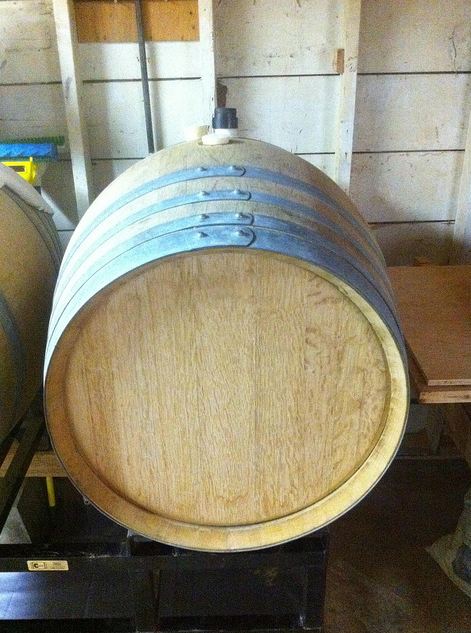
Back in May, I made the long drive over to Prosser, WA to pick up a freshly emptied white wine barrel from Maison Bleu Winery.  When I arrived though, the barrels were in such great shape and at such an affordable price that, considering the effort I went to in order to locate such a barrel, it only made sense that I come home with two.  At the time I didn’t have a plan for the second barrel (B2), but knowing that I had a number of homebrewing buddies eager to delve deeper into the world of sour beers, coming up with a plan would be a piece of cake…or so I thought.

For the first barrel project, Amalgamation Autonomous, each brewer worked within a group-defined set of guidelines to come up with their own recipe that, when combined with the other batches, would hopefully create a unique beer that would possess all the complexities that we intended to achieve.  Everyone’s beer was slightly different than the others, but on fill day, one of the batches stood out a bit for already being quite sour with an underlying lemony Brett funkiness.  Because this batch showed promise, was unique in that it was pre-soured with only Pediococcus and then fermented with only Brettanomyces Lambicus, it seemed like a solid candidate to base our B2 beer off of.

144 lbs of Grain
With a world of options to consider, we all seemed to like the idea of the Pedio/Brett beer for its simplicity, repeatability, and uniqueness.  Even though everyone agreed to the concept of Amalgamation Autonomous when we were designing it, down the road there was some concern about it being too much of a hodgepodge “throw everything into a bucket and hope for the best” type of beer.  With B2, we wanted to eliminate that worry by designing the beer from the finished product backwards using only one grain bill.  In doing so, we still wanted to incorporate a significant portion of unmalted wheat so that there would be plenty of long chain dextrins for the bugs to work on over time, but we also wanted the brew day(s) to be relatively simple by only using a single infusion mash.  In addition to the wheat, we wanted to differ the base beer from B1 by starting with a higher gravity and a bit darker color...which we partially accomplished by the addition of CaraMunich 40 and Special B.

Darker color than B1
As for the souring organisms, we liked the idea of only using Pedio and Brett.  According to most material I’ve read on brewing lambics and other wild ales, Pediococcus seems to be the bacterium that’s responsible for the majority of the lactic acid production and yet when you talk to other homebrewers/brewers, it’s rarely mentioned as an element that people focus on.  So, in order to highlight this critical critter of acid ales, we thought it would be fun to use it as the sole souring element in our beer.  Pedio does produce a ton of diacetyl though and without any other wild element in the beer, it would be rather one-dimensional.  To rid the beer of the diacetyl and provide the funky complex background, we decided to ferment the beer out with both Wyeast and White Labs’ strains of Brettanomyces Lambicus.

Ideally we would have liked to have pre-soured as much of the wort as possible with pedio before pitching in the Brett, but due to some logistical constraints, we had to come up with an alternative method.  After much debate and planning, we came up with a schedule that hopefully will still yield the same results yet is a little less risky.   Below is a condensed version of our brewing plans, but if you would like to see the full thing, you can view the entire document by clicking here.

20 gallons of Brett Lambicus beer waiting for the barrel
·         Brew 10 gallons of wort, chill to 90 degrees and transfer into C02 flushed corny kegs.  Inoculate with 1 liter of pedio and hold at 85 degrees until the first barrel fill day.

·         Brew 20 gallons of wort and split into two, 10 gallon batches.  Pitch Wyeast Brett Lambicus into one and White Labs Brett Lambicus into the other.  Ferment at about 80 degrees.

·         Barrel fill day.  Brew 30 gallons of wort and transfer directly into the barrel.  To this, add the 20 gallons of Brett fermented beer while reserving a little bit of the Brett yeast cake.  Transfer the pedio beer onto the leftover Brett yeast in the now empty carboys.

·         After primary fermentation has resided both inside the barrel and inside the carboys, rack the pedio/Brett fermented beers into the barrel and seal.

1 liter commercial pack of Pedio
One of the reasons for pre-souring the beer with pedio was not only just to lower the initial pH, but also to increase the overall amount of pedio in the beer.  It’s an anaerobic organism that typically doesn’t compete well with other microorganisms and really doesn’t get to work in a lambic until after the all of the oxygen has been consumed in the beer and the other organisms have completed the majority of their cycles (4-12 months).  Because of this, we wanted to give it as much of a head start as possible by introducing it as the sole organism in an oxygen free wort with the best possible nutrients for reproduction.  From talking with a few microbiologists, it sounds like bacteriological peptone is the perfect nutrient for propagating bacteria, but since none of them were able to provide me with any and the online suppliers only sell to labs/companies, we had to go with option number 2.  Apparently bacteria also love freshly dead yeast (provided their nutrients are accessible), so at the time of inoculating the wort with the Pediococcus, we also added about a half cup thick yeast slurry that was pressure cooked to burst the cell walls.  It certainly didn’t smell great and I’m slightly worried about how it’ll affect the end beer, but since Brett is great at cleaning up autolyzed yeast over time, hopefully it will go to town on the pressure cooked yeast as well.

Barrel #2

Recipe Specifics

Batch Size (Gal): 70
Total Grain (Lbs): 144
Anticipated OG: 1.055
Anticipated SRM: 10.0
Anticipated IBU: Less than 10
Wort Boil Time (mins): 60
Anticipated ABV: 7.25%

Grain

48.6% - 70 lbs Pale Malt
24.3% - 35 lbs Flaked Wheat
16.7% - 24 lbs Vienna Malt
8.3% - 12 lbs CaraMunich
2.1% - 3 lbs Special B

Hops

Varied.  Any variety added between 60 and 30 minutes contributing 10 IBUs or less.

­Yeast

White Labs 653 Brettanomyces Lambicus 
Wyeast 5526 Brettanomyces Lambicus
Wyeast 5733 Pediococcus

Mash Schedule

60 minutes @ 154°
15 minutes @ 168°
Sparge with 170° water

Notes

9/17/2011 – Nick brewed 10 gallons of wort, cooled to 75° and inoculated both carboys with Wyeast Brett Lambicus.  The yeast had been going on a stir plate for the past week and a half with 1 liter of 1.035 wort.

10/1/2011 – I brewed 10 gallons of wort and once it was cooled to 85°, I racked it into two C02 flushed corny kegs.  I then added the 1 liter commercial pack of Pediococcus that a local brewery ordered for us from Wyeast.  This all then went into my fermentation chamber where it was held @ 85° until the first barrel fill day.

10/2/2011 - Bob brewed up 10 gallons of wort, cooled to 75° and then inoculated both carboys with White Labs’ Brettanomyces Lambicus. 

10/9/2011 – Paul, Ben, and Brendan all brewed up 30 gallons of the wort, chilled to 70° and then racked directly into the barrel.  The yeast was roused in each of the four Brettanomyces carboys and all but about a cup from each was racked into the barrel. 

To make room for fermentation, about a third of each pedio corny keg was transferred into a third corny keg so that all three of them were filled to about 2/3rds the way full.  The 4 or so cups of Brettanomyces yeast slurry was then divided equally between the three kegs and they were allowed to ferment at 75°.

10/26/2011 – Activity from primary fermentation had slowed dramatically in both the barrel and the kegs, so we stirred up the kegs and transferred the remaining 10 gallons into the barrel.  We ended up with only about a quart of extra beer that didn’t fit in the barrel!

Related Posts Plugin for WordPress, Blogger...